FAQs
This page answers frequently asked questions about the public consultation on the future of the Passmore Edwards Municipal Building.
Frequently Asked Questions
This consultation is about the future of the Passmore Edwards Municipal Building on The Moor and how it can best serve the community in the years ahead. It focuses on the building’s role as the home of Falmouth Art Gallery, Falmouth Library, and key civic spaces, including the Council Chamber and Mayor’s Parlour.
The consultation is taking place at an early stage, before any final decisions are made.
The consultation began on 8 December 2025. This consultation remains open until 5pm 13 March 2026, and people are invited to share their views through the website and other engagement opportunities. Please visit our How to Take Part for more information.
No. This consultation forms part of the initial stage of the engagement process and focuses on gathering feedback on early ideas before any detailed proposals are developed. The draft plans and themes shown are illustrative and intended to support discussion. No final decisions have been made. Any future phases of consultation or engagement would be confirmed in due course.
As part of this consultation, we are exploring how library and gallery spaces and services could evolve over time to reflect how people use these services today and in the future. This could include layouts, flexibility of spaces, and how services work alongside other cultural and community uses within the building.
This consultation is about improving accessibility, use, and experience, not about reducing services.
The Mayor’s Parlour will remain where it is. The Council Chamber will remain in its current location, though the consultation is inviting views on how it could be better utilised.
No. The consultation is focused on improving how the building works as a shared civic and cultural space.
The draft plans are sometimes referred to as a “first straw man”. They are illustrative drawings that explore how the building could work in the future. They are not fixed designs and are subject to change following public feedback and funding considerations.
Showing early ideas helps make the consultation clearer and more meaningful. It allows people to comment on real possibilities rather than abstract concepts.
No. You do not need to read or interpret the plans to take part. Feedback based on your experience of using the building is equally valuable.
The early-stage feasibility work and draft proposals supporting this consultation were jointly funded by Falmouth Town Council and the Town Regeneration and Investment Programme (TRIP).
TRIP is part of the delivery of the UK Shared Prosperity Fund in Cornwall and sits within the Good Growth Programme, administered by Cornwall Council.
This funding has paid for the architects and specialist work needed to explore early ideas and support public consultation.
No. Any future work on the Municipal Building is dependent on securing further funding. The current consultation and draft plans are an early step to help shape proposals that could support future funding applications.
Yes. Falmouth Town Council has ring-fenced £180,000 for investment in the Passmore Edwards Municipal Building.
This funding comes from Falmouth’s new Second Home Levy. The Town Council has chosen not to rely on this levy as guaranteed income for expanding services, as it is subject to change. Instead, it has chosen to invest it in the Municipal Building.
The £180,000 ring-fenced funding is intended to be used as match funding for external grants that the Council may be eligible to apply for in future.
Having match funding in place strengthens funding bids but does not commit the Council to construction or final designs.
No. Any future phases of work would be subject to securing further funding, approvals, and consultation. No decisions have been made about construction.
The draft plans have been developed by a design team led by Studio Wignall and Moore, supported by local specialist sub-contractors. The team was appointed following an open and competitive procurement process. Any future stages of work would be subject to funding, approvals and further decisions by Falmouth Town Council.
Yes. Improving accessibility and environmental performance are key themes being explored. This includes ideas such as improved step-free access, clearer circulation, better wayfinding, insulation, energy efficiency, and resilience to climate change. These are early considerations and subject to further study.
Anyone. The consultation is open to residents, visitors, users of the building, community groups, artists, educators, businesses, and anyone with an interest in the future of the Municipal Building.
You can:
- Complete the online consultation survey. You do not need to read the supporting documents to take part. The survey takes around 5–10 minutes and will open in a new window.
- Share your views using our quick voice feedback tool (no typing required; opens in a new window) This tool is provided by a third-party supplier (Hoxton Analytics Limited).If you do not wish to provide personal information, please avoid including personal or sensitive information in your response.
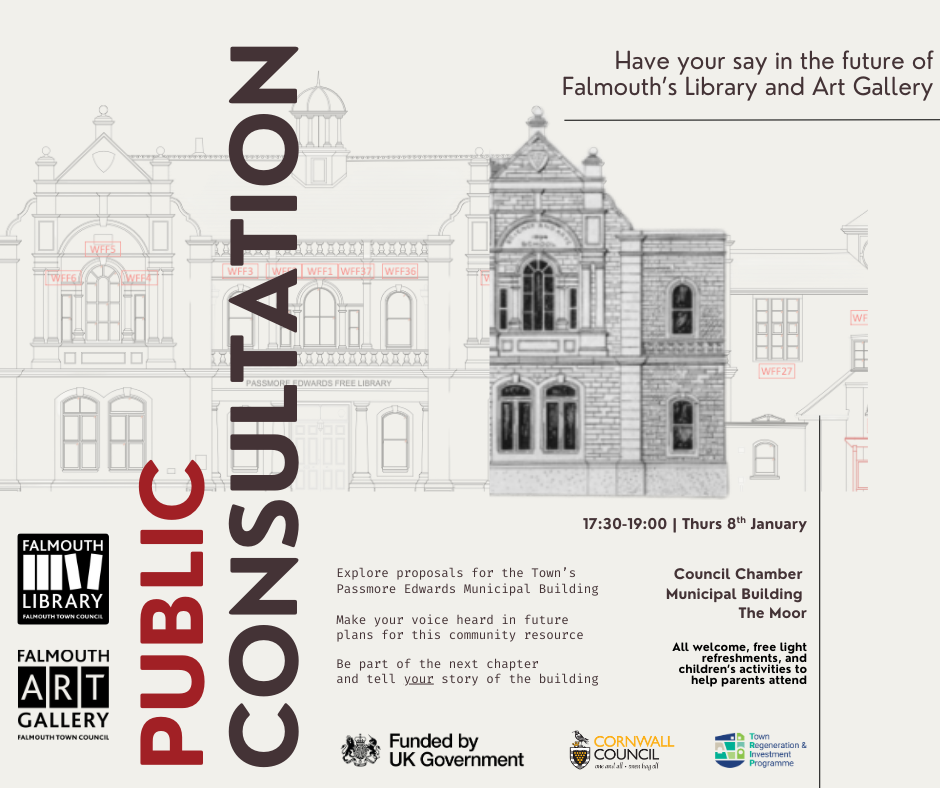
- Attend a public consultation event
- Email your comments
- Use the contact form on this website
- Visit the consultation exhibition
Details are available on the How to Take Part page.
All responses will be reviewed after the consultation closes and used to help inform the next stages of work. A summary of feedback and next steps will be published in due course.
If you have questions about the consultation or need help taking part, please contact:
Email: consultations@falmouthtowncouncil.com
Phone: 01326 315 559
Once the consultation closes, all feedback received will be reviewed and summarised.
The responses will be used to understand priorities, concerns, and opportunities identified by the community.
A summary of the consultation feedback and next steps will be published on the Town Council’s website.
Any future work on the Municipal Building would be subject to:
- the availability of external funding
- further design development
- appropriate approvals and decision-making
- additional public engagement
No final decisions have been made at this stage.